


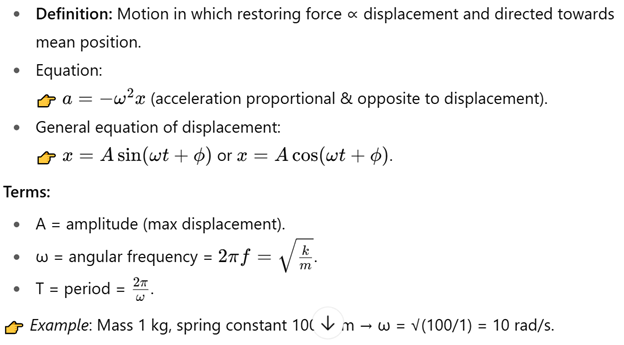
2.1 Equation of Simple Harmonic Motion (SHM)
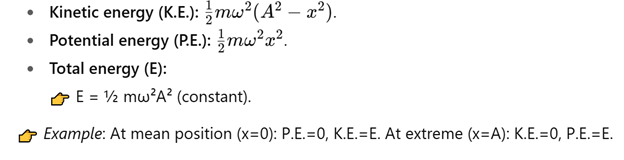
2.2 Energy in SHM
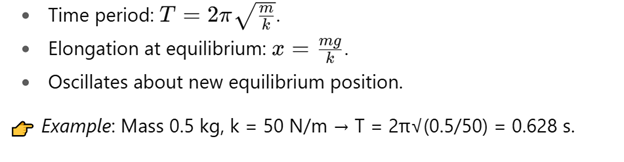
2.3 Vertical Oscillation of Mass on a Spring
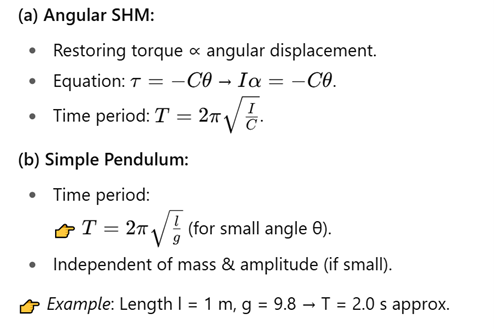
2.4 Angular SHM & Simple Pendulum
2.5 Oscillatory Motion (Damped, Forced & Resonance)
(a) Damped oscillation:
- Amplitude decreases gradually due to resistive force (air resistance, friction).
- Energy lost in each cycle.
(b) Forced oscillation:
- External periodic force applied to oscillator.
- Oscillator vibrates with frequency of driving force.
(c) Resonance:
- When driving frequency = natural frequency.
- Amplitude becomes maximum.
- Example: Breaking of glass by loud sound, soldiers not marching on bridge.
Important Questions and Answers in Short
Q1. Define SHM.
👉 Motion in which restoring force ∝ displacement and directed towards mean position.
Q2. Write equation of SHM.
👉 x = A sin(ωt + φ).
Q3. Write expressions for energy in SHM.
👉 K.E. = ½ mω²(A² − x²), P.E. = ½ mω²x², Total E = ½ mω²A².
Q4. Time period of vertical mass-spring system.
👉 T = 2π√(m/k).
Q5. Time period of simple pendulum.
👉 T = 2π√(l/g).
Q6. Define angular SHM.
👉 SHM where restoring torque ∝ angular displacement.
Q7. What is damping?
👉 Gradual decrease in amplitude due to resistive force.
Q8. Define forced oscillation.
👉 Oscillation under periodic external force.
Q9. Define resonance.
👉 Condition when driving frequency = natural frequency → maximum amplitude.
Q10. Give one example of resonance.
👉 Breaking of glass by sound of same frequency.
✅ Formula Sheet (Quick Revision):
- x = A sin(ωt + φ)
- ω = 2πf = √(k/m)
- T = 2π√(m/k) (spring), T = 2π√(l/g) (pendulum)
- K.E. = ½ mω²(A² − x²)
- P.E. = ½ mω²x²
- Total E = ½ mω²A²

