


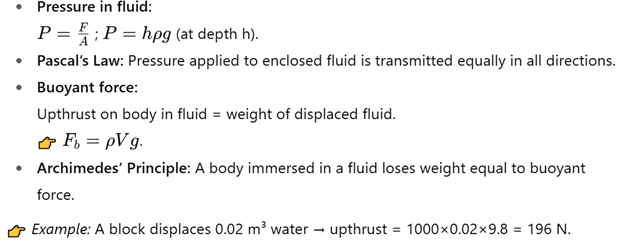
3.1 Fluid Statics: Pressure & Buoyancy
3.2 Surface Tension & Surface Energy
3.3 Angle of Contact & Capillarity
Angle of contact (θ): Angle between solid surface & tangent to liquid surface at point of contact.
Acute (wetting liquid, e.g. water-glass).
Obtuse (non-wetting, e.g. mercury-glass).
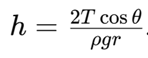
Capillarity: Rise or fall of liquid in a capillary tube.
- Applications:
- Rise of ink in pen.
- Rise of oil in wick of lamp.
- Water supply in plant stem.
3.4 Fluid Dynamics: Viscosity
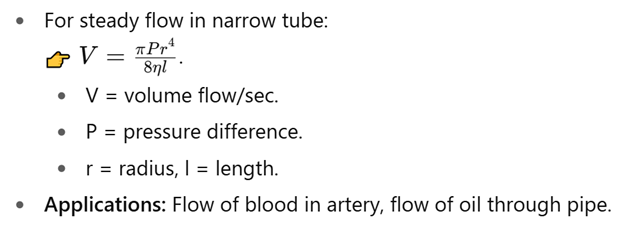
3.5 Poiseuille’s Formula
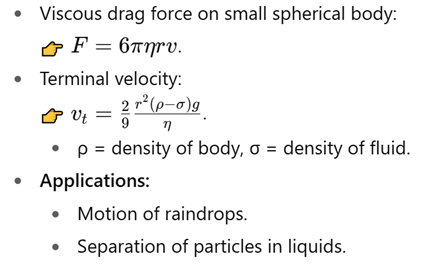
3.6 Stokes’ Law
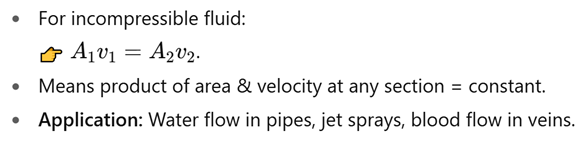
3.7 Equation of Continuity
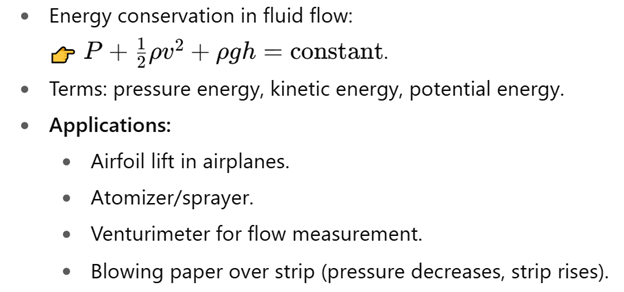
3.8 Bernoulli’s Equation
Important Questions and Answers in Short
Q1. Define pressure in a fluid.
👉 Pressure at depth h: P = hρg.
Q2. State Archimedes’ principle.
👉 Body immersed in fluid loses weight = weight of displaced fluid.
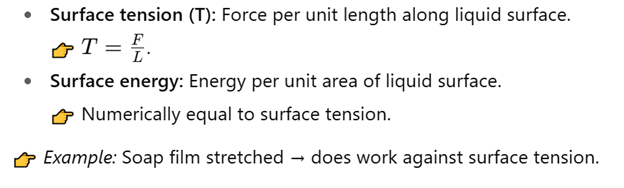
Q3. Define surface tension.
👉 Force per unit length acting along liquid surface.
Q4. What is surface energy?
👉 Energy per unit area of surface.
Q5. Define angle of contact.
👉 Angle between tangent to liquid surface & solid surface at point of contact.
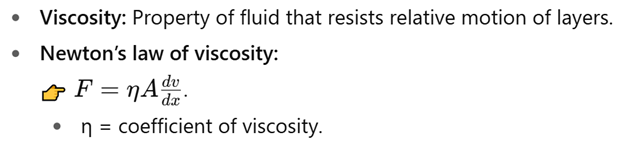
Q6. State Newton’s law of viscosity.
👉 It states that shear stress in a fluid is directly proportional to the velocity gradient (rate of shear strain).
Q7. State Stokes’ law.
👉 Viscous drag: F = 6πηrv.
Q12. State Bernoulli’s theorem.
👉 It states that for the steady flow of an incompressible, non-viscous fluid, the total mechanical energy along a streamline remains constant, i.e. P + ½ρv² + ρgh = constant.
Q13. Give two applications of Bernoulli’s theorem.
👉 Lift of airplane, atomizer spray.
✅ Formula Sheet (Quick Revision):
- Pressure: P = hρg
- Buoyancy: F = ρVg
- Surface tension: T = F/L
- Capillarity: h = 2T cosθ / (ρgr)
- Viscosity law: F = ηA dv/dx
- Poiseuille’s: V = πPr⁴ / (8ηl)
- Stokes’ law: F = 6πηrv, v_t = (2/9)(r²(ρ–σ)g/η)
- Continuity: A₁v₁ = A₂v₂
- Bernoulli: P + ½ρv² + ρgh = constant

