

4.1 Thermodynamic Systems
- System: Part of universe under study.
- Surroundings: Everything outside the system.
- Boundary: Real or imaginary surface separating system and surroundings.
Types of systems:
- Open system: Exchange of mass + energy. (e.g. boiling water in open vessel).
- Closed system: Exchange of energy, not mass. (e.g. gas in piston).
4.2 Work Done During Volume Change
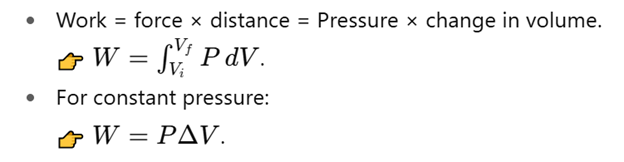
- If VVV increases → work done by system (+).
- If VVV decreases → work done on system (–).
Example: Gas expands from 2 m³ to 4 m³ at 100 Pa,
W=100×(4−2)=200J
4.3 Heat, Work & First Law of Thermodynamics

4.4 Thermodynamic Processes
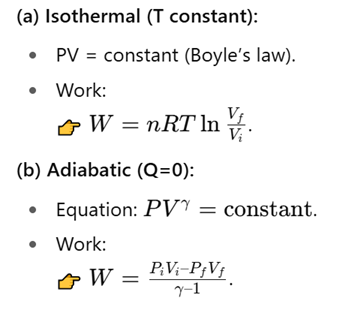
- Isothermal (T constant): ΔU = 0 → Q = W.
- Adiabatic (Q=0): ΔQ = 0 → ΔU = –W.
- Isochoric (V constant): W = 0 → Q = ΔU.
- Isobaric (P constant): Work = PΔV, Q = ΔU + PΔV.
4.5 Heat Capacities of Ideal Gas
4.6 Isothermal & Adiabatic Processes
Important Questions and Answers in Short
Q1. Define thermodynamic system.
👉 Portion of universe chosen for study.
Q2. Types of thermodynamic systems?
👉 Open, Closed, Isolated.
Q3. Work done at constant pressure?
👉 W = PΔV.
Q4. State first law of thermodynamics.
👉 ΔQ = ΔU + ΔW.
Q5. Write condition for isothermal process.
👉 T constant, ΔU=0, so Q=W.
Q6. Write condition for adiabatic process.
👉 Q=0, so ΔU=–W, PV^γ=constant.
Q7. Condition for isochoric process?
👉 V constant → W=0, so Q=ΔU.
Q8. Condition for isobaric process?
👉 P constant → W=PΔV.
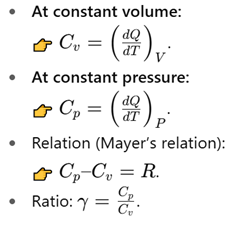
Q9. Define C_p and C_v.
👉 C_v = heat required per unit rise of T at constant V.
👉 C_p = heat required per unit rise of T at constant P.
Q10. State Mayer’s relation.
👉 C_p – C_v = R.
Q11. Work done in isothermal expansion of gas.
👉 W = nRT ln(Vf/Vi).
Q12. Work done in adiabatic expansion.
👉 W = (P_iV_i – P_fV_f)/(γ–1).
✅ Formula Sheet (Quick Revision):
- W = ∫PdV
- ΔQ = ΔU + ΔW
- Isothermal: ΔU=0, W = nRT ln(Vf/Vi)
- Adiabatic: PV^γ = const, W = (PiVi – PfVf)/(γ–1)
- Isochoric: W=0 → Q=ΔU
- Isobaric: W = PΔV
- C_p – C_v = R, γ = C_p/C_v

