6.1 Progressive Waves
- Definition: Wave that transfers energy and momentum from one point to another without transfer of matter.
- Types:
- Transverse: Particle displacement ⟂ direction of wave (e.g., water waves, light).
- Longitudinal: Particle displacement ∥ direction of wave (e.g., sound waves).
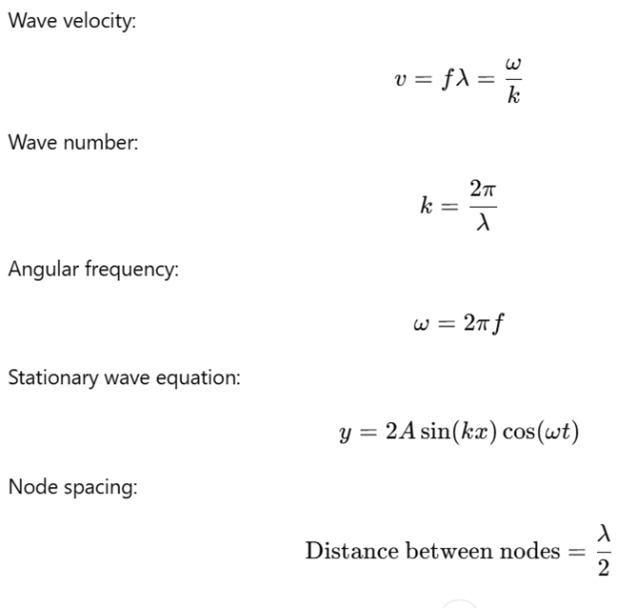
- Wave velocity (v):

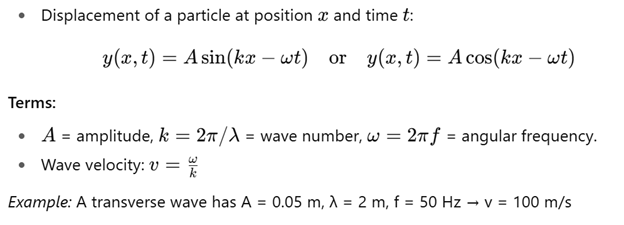
6.2 Mathematical Description of a Wave
6.3 Stationary Waves
- Definition: Result of superposition of two identical waves moving in opposite directions.
- Characteristics:
- Nodes: points of zero amplitude.
- Antinodes: points of maximum amplitude.
- Distance between adjacent nodes: λ/2
- Wave equation: Same as progressive, but with superposition:

Important Questions and Answers in Short
Q1. Define progressive wave.
👉 A wave that transfers energy and momentum without transferring matter.
Q2. Types of progressive waves?
👉 Transverse (⊥), Longitudinal (∥).
Q3. Relation between wave velocity, frequency, and wavelength?
👉 v=fλ
Q4. Write mathematical equation of a wave.
👉 y=Asin(kx−ωt)
Q5. Define stationary wave.
👉 Wave formed by superposition of two identical waves moving opposite directions.
Q6. What is a node?
👉 Point of zero amplitude in stationary wave.
Q7. What is an antinode?
👉 Point of maximum amplitude in stationary wave.
Q8. Distance between adjacent nodes/antinodes?
👉 λ/2
✅ Formula Sheet (Quick Revision)