


24.1 Alpha, Beta & Gamma Particles
- α-particle → Helium nucleus (2p + 2n), +2 charge, heavy, low penetration (stopped by paper).
- β-particle → Electron (β⁻) or positron (β⁺), light, medium penetration (stopped by Al sheet).
- γ-ray → High-energy EM wave, no mass/charge, high penetration (needs lead block).
24.2 Laws of Radioactive Disintegration
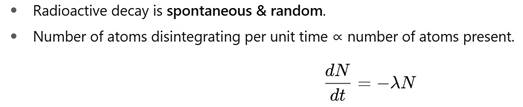
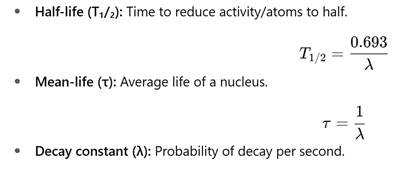
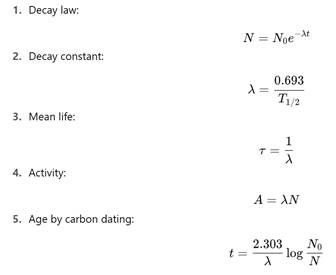
24.3 Half-life, Mean-life & Decay Constant
24.4 Geiger-Muller Tube
- Detects α, β, γ radiation.
- Filled with gas → ionized by radiation → produces pulse → counted electronically.
24.5 Carbon Dating
- Based on radioactive isotope C-14 (half-life = 5730 years).
- Living organisms maintain constant C-14/C-12 ratio.
- After death, C-14 decays → measure remaining C-14 to estimate age.
24.6 Medical Use & Hazards
- Uses: Cancer treatment (radiotherapy), tracers in diagnosis, sterilization of instruments.
- Hazards: Tissue damage, mutation, cancer risk, radiation sickness if exposed too much.
Short Questions and Answers in Short
Numerical Examples
✅ Formula Sheet (Quick Revision)
Q1. What is an α-particle?
Ans: Helium nucleus (2 protons + 2 neutrons).
Q2. Which radiation has highest penetrating power?
Ans: Gamma rays.
Q3. Write the law of radioactive decay.
Ans: Rate of disintegration ∝ number of nuclei present.
Q4. Define half-life.
Ans: Time taken for half of the radioactive nuclei to decay.
Q5. Relation between half-life & decay constant?
Ans: T1/2 = 0.693/ λ
Q6. What is carbon dating used for?
Ans: To find the age of fossils/archaeological samples.
Q7. Mention one medical use of radiation.
Ans: Radiotherapy in cancer treatment.
Q8. What is the working principle of G-M tube?
Ans: Ionization of gas molecules by radiation produces pulses.
Q9. Define mean life.
Ans: Average lifetime of a radioactive nucleus = = 1/λ
Q10. Why is γ-ray more dangerous than α?
Ans: Due to high penetration power.
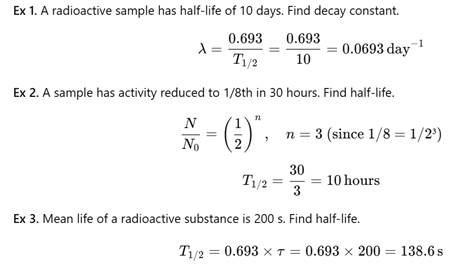
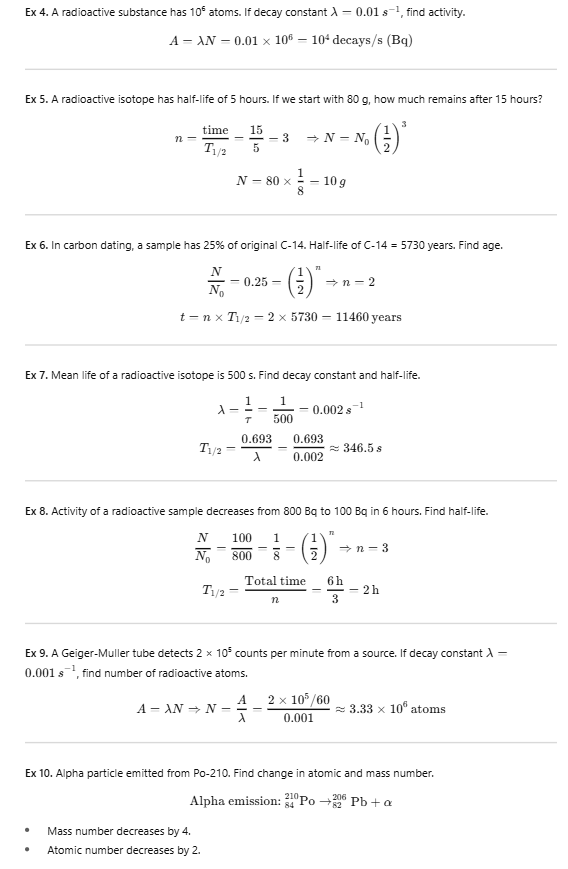
Numerical Examples
✅ Formula Sheet (Quick Revision)
Comparison of α, β, and γ Radiations
| Property | α-particles (Alpha) | β-particles (Beta) | γ-rays (Gamma) |
| Nature | Helium nucleus (₂He⁴) | Electron (β⁻) or Positron (β⁺) | Electromagnetic wave (photon) |
| Mass | 4 amu (≈ 6.64 × 10⁻²⁷ kg) | 1/1837 amu (≈ 9.1 × 10⁻³¹ kg) | Zero |
| Charge | +2e | –e (electron) or +e (positron) | 0 (neutral) |
| Speed | ≈ 10⁷ m/s (slow) | ≈ 10⁸ m/s (fast, near c) | c (speed of light) |
| Penetrating Power | Very low (stopped by paper) | Moderate (stopped by few mm Al) | Very high (needs thick lead) |
| Ionization Power | Very high | Moderate | Very low |
| Deflection (E & B field) | Small (heavy, +ve charge) | Large (light, –ve or +ve charge) | No deflection (neutral) |
| Biological Effect | Dangerous if ingested/inhaled | Can penetrate skin, harmful | Deep penetration, highly harmful |

