10.1 Huygen’s Principle
- Definition: Every point on a wavefront acts as a secondary source of spherical wavelets. The new wavefront is the envelope of these wavelets.
- Applications:
- Explains reflection and refraction of light
- Explains diffraction
Example: Plane wavefront striking a glass surface → secondary wavelets form the refracted wavefront inside glass.
10.2 Reflection and Refraction (Wave Theory)
Reflection:
- Angle of incidence = angle of reflection
- Wavefronts maintain shape, direction changes
Refraction:
- Light changes speed in new medium → direction bends
- Snell’s law (wave theory):
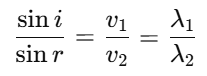
i = angle of incidence, r = angle of refraction, v = wave velocity, λ = wavelength
Key points:
- Frequency (f) remains constant
- Wavelength (λ) changes in medium
- Velocity (v) changes in medium
Example: Light enters glass (n ≈ 1.5), speed in air 3 × 10⁸ m/s → speed in glass:

Important Short Questions and Answers in Short
Q1. State Huygen’s principle.
👉 Every point on a wavefront acts as a secondary source; new wavefront = envelope of wavelets.
Q2. What phenomena can Huygen’s principle explain?
👉 Reflection, refraction, diffraction.
Q3. Angle of incidence = ?
👉 Angle of reflection (law of reflection)
Q4. What changes and remains constant during refraction?
- Frequency f = constant
- Wavelength λ = changes
- Velocity v = changes
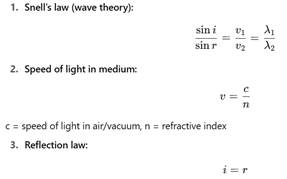
✅ Formula Sheet (Quick Revision)
Numerical Examples
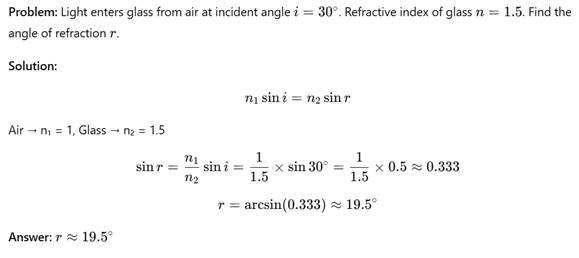
Example 1: Snell’s Law – Refraction at glass surface
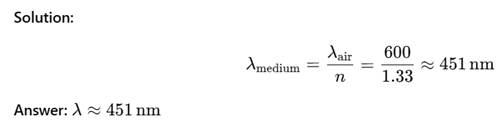
Example 2: Wavelength change in medium
Problem: Light of wavelength λ=600 nm in air enters water (n = 1.33). Find wavelength in water.
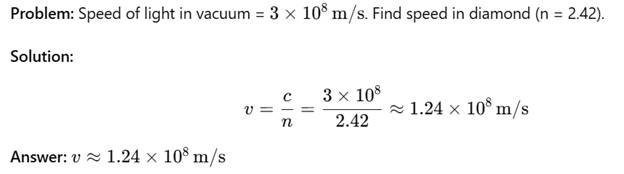
Example 3: Speed of light in different medium
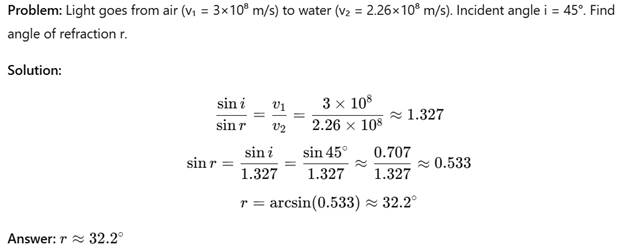
Example 4: Angle of refraction using velocity ratio