13.1 Phenomenon of Polarization
- Definition: Polarization is the process in which light waves vibrate in a particular direction instead of all directions.
- Only transverse waves (like light) can be polarized.
- Methods of polarization:
- Reflection (off glass/water surface)
- Refraction (Brewster’s angle)
- Polaroid sheets (absorption)
Example: Sunglasses use polarizing filters to block glare from reflected sunlight.
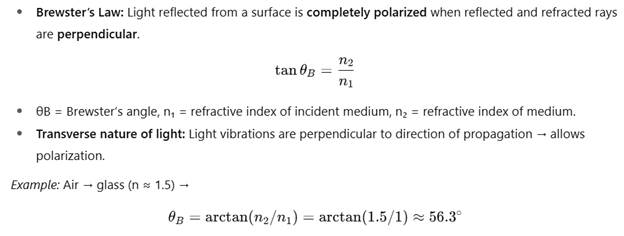
13.2 Brewster’s Law; Transverse Nature of Light
13.3 Polaroid
- Polaroid: A material or sheet that absorbs light vibrating in one direction and transmits light vibrating perpendicular to it.
- Used in:
- Sunglasses
- Photography
- LCD screens
- Unpolarized light → Polaroid → linearly polarized light
Important Short Questions and Answers in Short
Q1. Define polarization.
👉 Restriction of light vibrations to a particular direction.
Q2. Can longitudinal waves be polarized?
👉 No, only transverse waves can be polarized.
Q3. What is a Polaroid?
👉 A sheet that transmits light vibrating in one direction and absorbs the perpendicular component.
Q4. Applications of Polaroid?
👉 Sunglasses, photography, LCD screens.
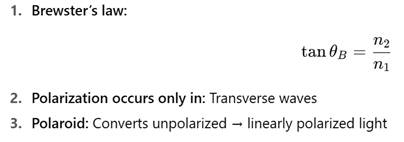
✅ Formula Sheet (Quick Revision)
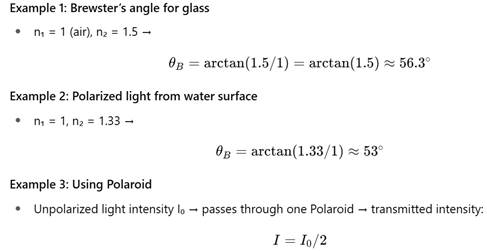
Numerical Examples