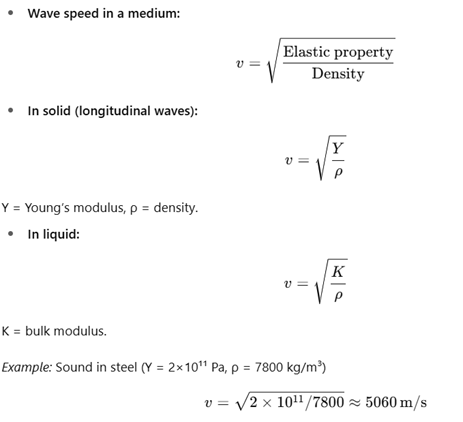
7.1 Speed of Wave Motion; Velocity of Sound in Solid & Liquid
7.2 Velocity of Sound in Gas
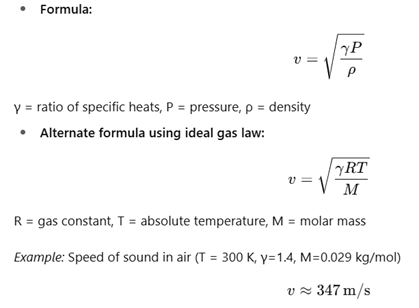
7.3 Laplace’s Correction
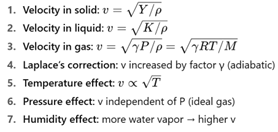
- Observation: Experimental velocity of sound in air is slightly higher than P/ρ\sqrt{P/\rho}P/ρ predicted by simple theory.
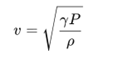
- Reason: Air is not isothermal, but adiabatic → correction factor γ.
- Formula:
γ = 1/4 for air
7.4 Effect of Temperature, Pressure & Humidity
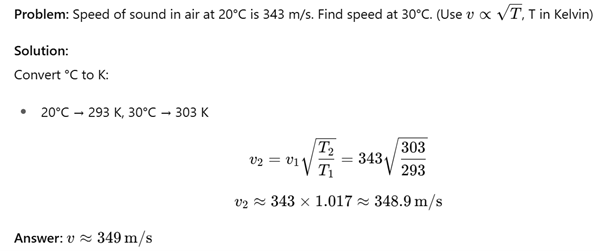
- Temperature: v ∝ √T → higher temperature, faster sound.
- Pressure: For ideal gas at constant T, v independent of P.
- Humidity: More water vapor → lower density → higher speed of sound.
Example: Air at 20°C → v ≈ 343 m/s; at 30°C → v ≈ 349 m/s
Important Questions and Answers in Short
Q1. What is Laplace’s correction?
👉 Corrects sound velocity in gas from isothermal to adiabatic conditions.
Q2. Effect of temperature on sound velocity?
👉 v ∝ √T → higher temperature → faster sound.
Q3. Effect of pressure on sound velocity?
👉 v independent of P for ideal gas at constant T.
Q4. Effect of humidity on sound velocity?
👉 More humidity → faster sound.
✅ Formula Sheet (Quick Revision)
Numerical Examples
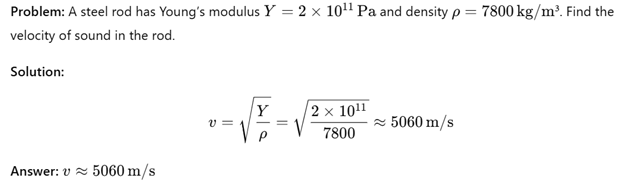
Example 1: Velocity of Sound in Solid
Example 2: Effect of temperature on velocity of sound
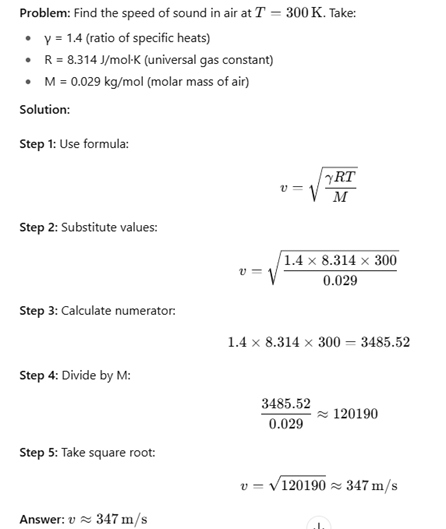
Example 3: Velocity of sound in Gas (air)