


Basic Concept of Cost
Cost (लागत) refers to the total expenditure incurred by a producer in the process of producing goods and services. It includes all payments made for the use of resources (स्रोत) such as land, labor, capital, and entrepreneurship.
There are various concepts of cost, which are discussed below:
- Money Cost (मौद्रिक लागत):
The actual money expenditure (नगद खर्च) incurred in producing goods and services. - Real Cost (वास्तविक लागत):
The sacrifice (त्याग) of efforts, time, and pain made by owners of factors of production. - Opportunity Cost (अवसर लागत):
The value of the next best alternative (अर्को उत्तम विकल्पको मूल्य) forgone when one option is chosen. - Explicit Cost (प्रत्यक्ष लागत):
The actual payments (वास्तविक भुक्तानी) made to outsiders for inputs like wages, rent, and raw materials. - Implicit Cost (अप्रत्यक्ष लागत):
The imputed value (अनुमानित मूल्य) of self-owned resources used in production.
Short-Run Cost (छोटो अवधिको लागत):
In the short run (छोटो अवधि), some factors of production like land and capital are fixed (स्थिर), while others like labor and raw materials are variable (परिवर्तनीय).
Therefore, the short-run cost refers to the total cost of production when at least one factor is fixed and output can be changed only by varying the variable factors.
It includes:
- Fixed Cost (स्थिर लागत) – cost that does not change with output.
- Variable Cost (परिवर्तनीय लागत) – cost those changes with output.
- Total Cost (कुल लागत) – sum of fixed and variable costs.
Differences between Fixed Cost and Variable Cost
| Basis | Fixed Cost (स्थिर लागत) | Variable Cost (परिवर्तनीय लागत) |
| Meaning | Cost that does not change with the level of output. | Cost those changes with the level of output. |
| Relation with Output | Remains constant even if output is zero or increases. | Increases or decreases as output changes. |
| Example | Rent, insurance, salaries of permanent staff. | Raw materials, wages of labor, electricity. |
| Time Period | Exists only in the short run. | Exists in both short run and long run. |
| Nature | It is uncontrollable in the short run. | It is controllable as it depends on production level. |
The Concept of Total Cost, Marginal Cost and Average Cost
1. Total Cost (TC) – कुल लागत
- It is the sum (जम्मा) of all costs incurred in production.
- Formula:
TC=TFC+TVCTC = TFC + TVCTC=TFC+TVC
where,
TFC = Total Fixed Cost (स्थिर लागत)
TVC = Total Variable Cost (परिवर्तनीय लागत)
- Example: If fixed cost = Rs. 500 and variable cost = Rs. 300, then TC = Rs. 800.
2. Marginal Cost (MC) – सीमान्त लागत
- It is the additional cost (थप लागत) incurred in producing one more unit of output.
- Formula:
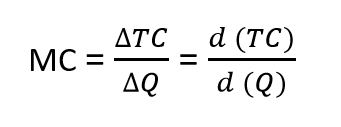
where ΔTC = change in total cost and ΔQ = change in output.
- Example: If TC increases from Rs. 800 to Rs. 900 when output rises from 10 to 11 units,
then MC = (900 − 800) / (11 − 10) = Rs. 100.
3. Average Cost (AC) – औसत लागत
- It is the cost per unit (प्रति इकाई लागत) of output produced.
- Formula:
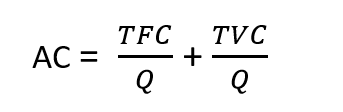
- It can also be written as:
AC = AFC + AVC
where, AFC = Average Fixed Cost, AVC = Average Variable Cost.
In short:
- TC shows total expenditure,
- MC shows cost of producing one more unit, and
- AC shows cost per unit of output.
Short-Run Total Costs
There are three types of short-run costs: total fixed cost, total variable cost, and total cost.
- Total Cost (TC – कुल लागत / कुल खर्च): Total Cost refers to the overall expenditure (कुल खर्च) a producer incurs to produce a given level of output in the short run, including both costs that remain fixed (स्थिर लागत) and costs that vary with production (परिवर्तनीय लागत).
- Total Fixed Cost (TFC – कुल स्थिर लागत):
- Total Fixed Cost is the portion of total cost (कुल लागतको भाग) that remains constant (स्थिर रहन्छ) regardless of the level of output produced in the short run.
- These costs are unaffected by production changes (उत्पादन परिवर्तनले असर गर्दैन) and must be paid even if output is zero.
- Examples: Rent of building, salaries of permanent staff, insurance.
3. Total Variable Cost (TVC – कुल परिवर्तनीय लागत):
- Total Variable Cost is the portion of total cost (कुल लागतको भाग) that changes with the level of output (उत्पादनको स्तर अनुसार परिवर्तन हुन्छ) in the short run.
- These costs increase as production increases and decrease if production falls.
- Examples: Wages of labor, raw materials, fuel, electricity.
The relationship between the total, fixed and variable cost is illustrated with the help of table.
Short-Run Total Costs
| Quantity of Output(Q) | TFC | TVC | TC = TFC + TVC |
| 0 | 50 | 0 | 50 |
| 1 | 50 | 20 | 70 |
| 2 | 50 | 35 | 90 |
| 3 | 50 | 50 | 100 |
| 4 | 50 | 85 | 125 |
| 5 | 50 | 140 | 180 |
In the table, the Total Fixed Cost (TFC – कुल स्थिर लागत) remains constant at 50, showing that fixed costs do not change with the level of output. The Total Variable Cost (TVC – कुल परिवर्तनीय लागत) increases as output rises, starting slowly at lower levels (20 → 35 → 50) and rising faster at higher levels (85 → 140), reflecting the law of diminishing returns. The Total Cost (TC – कुल लागत), which is the sum of TFC and TVC, also increases with output, from 50 for zero production to 180 for five units. This table illustrates how short-run costs behave (छोटो अवधिको लागतको व्यवहार): fixed costs remain unchanged, variable costs rise with production, and total cost increases as output grows.
Geometry of Short – Run Total Costs
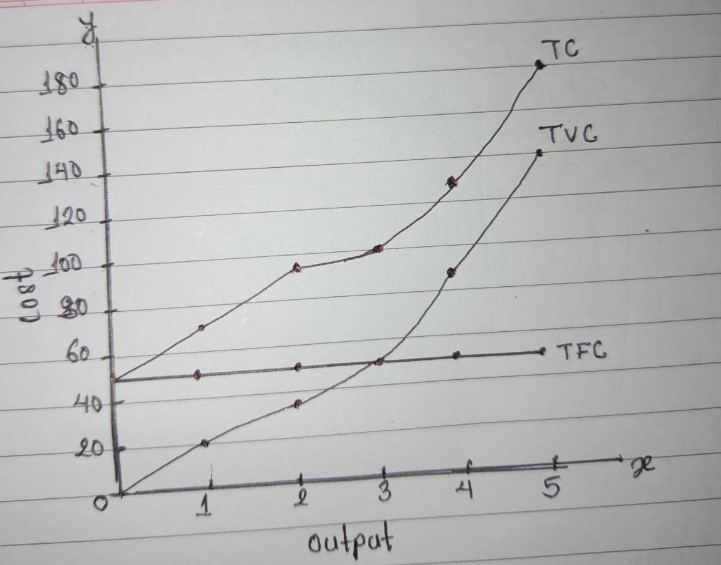
Thegraph shows the relationship between output and different types of costs: Total Fixed Cost (TFC), Total variable Cost (TVC) and Total Cost (TC). The total fixed cost remains constant at all levels of output, shown by the horizontal line, because fixed costs do not change with production. The total variable cost increases since variable costs depend on the level of the production. The total cost curve starts from the same point as TFC and rises as TVC increases, because Total cost is the sum of the Total fixed Cost and Total Variable Cost. This graph clearly shows that as output rises, variable and total cost increase while fixed cost remain constant.
Short-Run Average or Per Unit Costs
There are four kinds of short-run per unit cost of production. They are average fixed cost (AFC), average variable cost (AVC) and average total cost (AVC) or simply average cost (AC), and marginal cost (MC).
Average Fixed Cost (AFC): Average Fixed Cost (AFC) is the per unit fixed cost of production. AFC at each level of production an be found by dividing the total fixed cost by the corresponding level of output(Q). Mathematically,
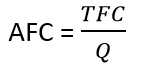
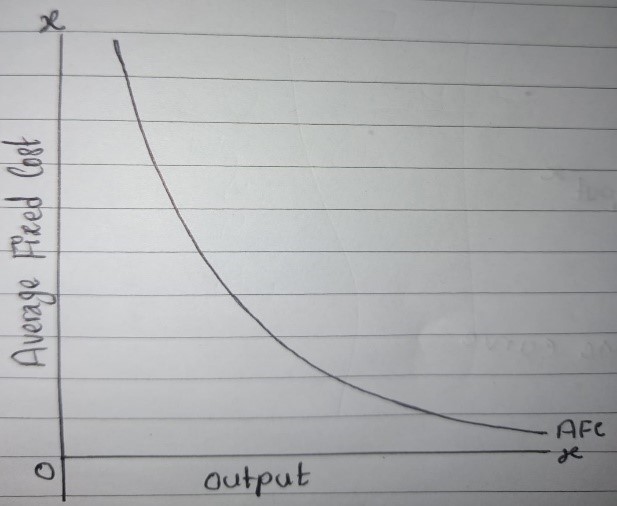
Graphically, average fixed cost curve is a rectangular hyperbola as shown in figure. It indicates that a very low level of output AFC is high through it declines continuously as production increases but remains positive.
Average Variable Cost (AVC): Average variable cost is the per unit variable cost of production. It is calculated by dividing total variable cost (TVC) by the corresponding level of output (Q). That is, AVC =
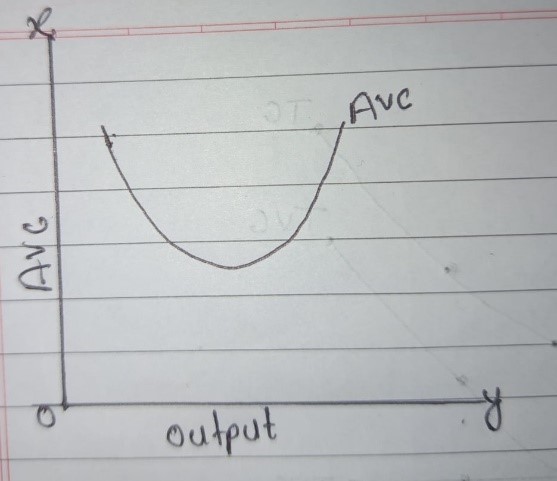
The diagram represents the average cost curve, showing the relationship between cost and output. The curve is U-shaped, meaning this as output increases, the average cost of production first decreases and increases. In the beginning, costs fall because of better utilization of resources and economies of scale. However, after reaching a certain level of output, the average cost begins to rise due to inefficiencies and diseconomies of scale.
Average Total Cost (ATC)/ Average Cost (AC): Average total cost is per unit cost of production. Average cost, at each level of output is calculated by dividing total cost by the corresponding level of output. So,
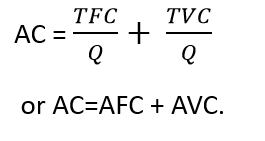
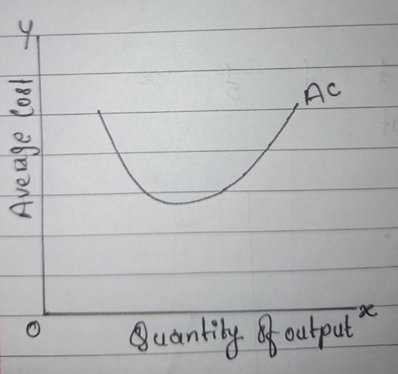
Since total cost is the sum of total fixed and total variable costs, average co also the sum of average fixed cost and average variable cost.
AC=AFC + AVC.
Graphically, AC at each level of output is represented by the distance on the vertical axis of total cost curve divided by the corresponding horizontal distance of it. In other words, average total cost curve is the vertical summation of average fixed cost curve and average variable cost curve. Average cost curve is a U-shaped curve because of the U-shaped average variable cost curve resulting from the operation of the law of diminishing marginal returns or the law of variable proportions.
Marginal Cost (MC): Marginal cost is the additional cost on total cost added by the production of one more unit of output. Marginal cost is defined as the change in total cost resulting from one unit change in the level of output produced. Mathematically,
MCn = TCn – TCn-1
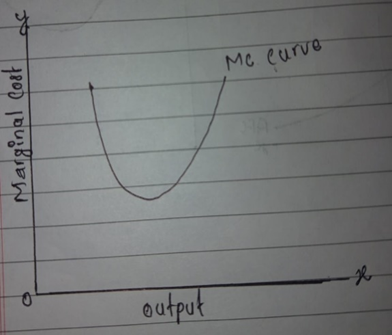
Short-run MC curve is shown in Figure. It is also a U-shaped curve, which shows that MC declines sharply, reaches a minimum point, and then rises sharply. This shows that the variable cost and the total cost increase first by decreasing amounts and then by increasing amounts.
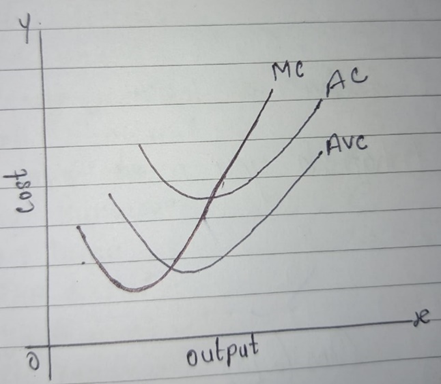
Relationship between MC, AVC, and AC
This diagram shows the relationship between short-run cost curves: Marginal Cost (MC), Average Cost (AC), and Average Variable Cost (AVC). All these curves are U-shaped because of the law of variable proportions, which means that initially, as production increases, costs fall due to increasing efficiency, but after a certain point, costs begin to rise due to diminishing returns. The MC curve cuts both the AC and AVC curves at their minimum points, showing the relationship between them. When MC is below AC or AVC, the averages fall, and when MC is above them, the averages rise. The vertical gap between AC and AVC represents Average Fixed Cost (AFC), which continuously decreases as output increases. Thus, the diagram explains how marginal cost influences average costs in the short run.
Relation between AC and MC
The amount of money spent in producing goods and services is called cost. Average cost is defined as per unit cost of production. It is calculated by dividing total cost by the units of output produced. Symbolically, AC =
Marginal cost is defined as the additional cost on total cost added by producing one more unit of output. Symbolically, MCn = TCn – TC(n-1)
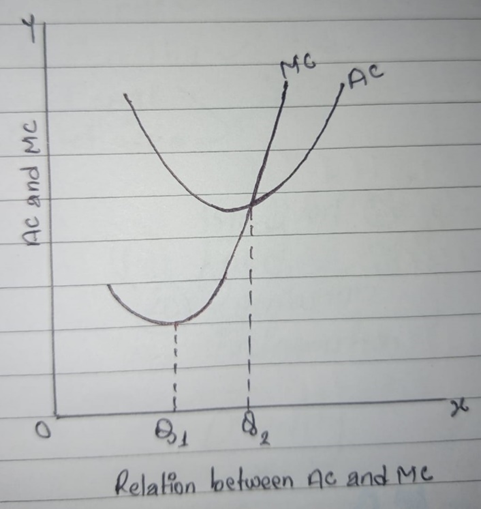
This diagram shows the relationship between Average Cost (AC) and Marginal Cost (MC). Both curves are U-shaped due to the law of variable proportions (परिवर्तनशील अनुपातको नियम). When the marginal cost (MC) is below the average cost (AC), the average cost decreases (औसत लागत घट्दै जान्छ). When the MC curve cuts the AC curve, the average cost reaches its minimum point (औसत लागत न्यूनतम बिन्दुमा पुग्छ). After this point, when MC is greater than AC, the average cost starts rising (औसत लागत बढ्न थाल्छ). Thus, the MC curve intersects the AC curve at its lowest point, showing that marginal cost determines the behavior of average cost in the short run (छोटो अवधिमा सीमान्त लागतले औसत लागतको चाल निर्धारण गर्छ)।
Relation between AC and MC curves
- Both AC and MC curves are U-shaped – due to the law of variable proportions (परिवर्तनशील अनुपातको नियम), meaning costs first fall and then rise.
- When MC is less than AC, the AC curve falls – because the additional unit costs less than the average (औसत लागत घट्दै जान्छ)।
- When MC equals AC, the AC curve is at its minimum point – MC cuts the AC curve at this point (MC र AC न्यूनतम बिन्दुमा एक–अर्कालाई काट्छन्)।
- When MC is greater than AC, the AC curve rises – because the additional unit costs more than the average (औसत लागत बढ्न थाल्छ)।
- The MC curve always intersects the AC curve at its lowest point, showing that marginal cost controls the movement of average cost (सीमान्त लागतले औसत लागतको चाल निर्धारण गर्छ)।
Why is SAC ‘U’ shaped?
- Increasing returns phase (लाभ बढ्ने चरण):
In the beginning, as production increases, fixed factors are used more efficiently, and average cost falls. - Constant returns phase (स्थिर लाभ चरण):
After a certain level of output, efficiency remains constant, and average cost reaches its minimum point. - Diminishing returns phase (लाभ घट्ने चरण):
When production increases further, fixed factors become overused, efficiency declines, and average cost starts rising. Therefore, the SAC curve first slopes downward, reaches a minimum point, and then slopes upward, forming a U-shape.
Long-Run Cost Curve
The Long-Run Average Cost (LAC) curve shows the minimum average cost of producing different levels of output when all factors of production are variable. In the long run, there are no fixed costs, and firms can change plant size or scale of operation to achieve the lowest possible cost. In simple words:
The LAC curve is the envelope curve of all short-run average cost (SAC) curves, representing the least cost combination of inputs for each level of output. (दीर्घ अवधिको औसत लागत वक्रले सबै उत्पादन तत्वहरू परिवर्तन गर्न सकिने अवस्थामा विभिन्न उत्पादन स्तरमा न्यूनतम औसत लागत देखाउँछ।)
Derivation of long-run average cost curve
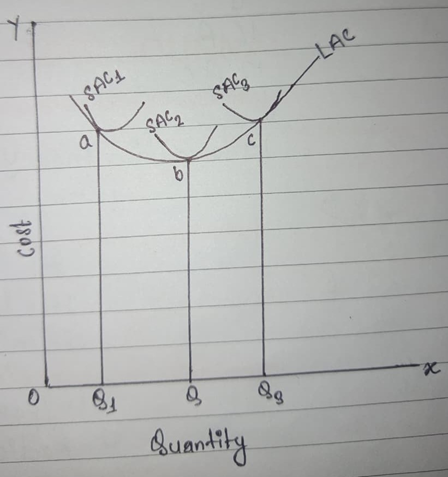
This diagram shows the Long-Run Average Cost (LAC) curve and a series of Short-Run Average Cost (SAC) curves. Each SAC curve (SAC₁, SAC₂, SAC₃) represents the cost of production for a particular plant size or scale in the short run. The LAC curve is formed as a smooth curve touching each SAC curve at its lowest point, showing the minimum possible cost of producing each level of output when all factors are variable. In the beginning, as output increases, the LAC curve slopes downward due to economies of scale (लाभ बढ्ने अवस्था), indicating lower average cost. After reaching the minimum point, the LAC curve slopes upward due to diseconomies of scale (लाभ घट्ने अवस्था), showing that costs rise as production expands beyond the optimum level. Thus, the LAC curve is also U-shaped, representing the least cost combination of inputs for different levels of production in the long run.

