

Introduction to Economics
Defining economics is not simple because there is no single agreed-upon definition. Over time, economists have described it in different ways. Adam Smith, the “father of economics,” saw it as the study of how and why a country becomes wealthy. Alfred Marshall explained it as the study of how people behave in everyday life, especially in acquiring and using resources for their well-being. Lionel Robbins gave a precise definition, stating that economics is the scientific study of how people decide to use limited resources to achieve different objectives. P.A. Samuelson added that economics examines how individuals and society produce goods and services and distribute them among different people and groups. Despite differences, all definitions focus on scarcity, choice, and resource allocation.
Economics is a social science because it studies human behavior and decision-making regarding limited resources. People aim to make the most of their resources such as time, money, labor, and knowledge by producing goods and services that satisfy their wants. Since resources are limited and wants are unlimited, individuals and societies must make choices and prioritize how to use these resources efficiently. Over time, economics has grown in scope and complexity, with thinkers like Milton Friedman, Friedrich Hayek, and John Maynard Keynes emphasizing different aspects such as scarcity, markets, and government policies. Today, economics helps understand human behavior, predict outcomes, and guide decisions to use resources effectively.
Scarcity and Choice
The concept of scarcity and choice was introduced by British economist Lionel Robbins in 1932 and remains a central idea in economics. Scarcity arises because human wants are unlimited while productive resources—such as labor, natural resources, and capital are limited. This imbalance between unlimited wants and limited resources leads to economic problems. Economics, as a social science, studies how individuals and societies make decisions to use scarce resources to satisfy their needs and wants. All resources are used to produce goods and services, which are therefore also limited, creating a conflict between available resources and human desires. Since people cannot have everything they want, there must be a system to distribute resources efficiently.
Scarcity and choice are central ideas in economics.
Scarcity means that resources are limited while human wants are unlimited, so there are not enough land, labor, money, or materials to satisfy all desires. Because of this, people and societies cannot have everything they want, and they must use resources carefully and efficiently. Scarcity also gives value to resources, showing why some things are more important or useful than others.
Choice is the process of deciding which wants to satisfy when resources are limited. Since it is impossible to fulfill all desires, people must prioritize their needs and use resources in a way that provides the maximum benefit or satisfaction. Making choices helps individuals and societies allocate resources efficiently, determining what to produce, how to produce, and for whom to produce, and it is the solution to the problems caused by scarcity.
Opportunity Cost
Opportunity cost is the value of the next best alternative that you give up when making a choice. Every time we make a decision, resources like time, money, or effort are limited, so choosing one option means we cannot choose another. The opportunity cost helps us understand what we are sacrificing in order to get something else.
For example, if you spend your afternoon watching a movie instead of working on a project, the opportunity cost is the progress you could have made on the project. Similarly, if a government spends money on building a road instead of a school, the opportunity cost is the benefit the school could have provided.
It’s a way of thinking about “what we lose by choosing one thing over another” and helps in making better decisions.
Suppose a factory can produce cars or bikes in one day. The resources are limited, so producing more of one means producing less of the other.
| Cars Produced | Bikes Produced | Opportunity Cost |
| 0 | 10 | – |
| 1 | 9 | 1 bike |
| 2 | 8 | 1 bike |
| 3 | 6 | 2 bikes |
| 4 | 3 | 3 bikes |
| 5 | 0 | 3 bikes |
How this works:
- Moving from 0 → 1 car: lose 1 bike, so opportunity cost = 1 bike.
- Moving from 2 → 3 cars: lose 2 bikes, so opportunity cost = 2 bikes.
- Moving from 4 → 5 cars: lose 3 bikes, so opportunity cost = 3 bikes.
This table now matches mathematically and shows that producing more of one good always comes at the cost of the other.
The table illustrates the concept of opportunity cost in production. It shows how a factory must choose between producing cars and bikes because resources are limited. The “Opportunity Cost” column indicates how many bikes the factory has to give up to produce an additional car. Initially, producing the first car costs only 1 bike, but as car production increases, the factory must sacrifice more bikes for each extra car—for example, producing the fourth car costs 3 bikes. This demonstrates the idea of increasing opportunity cost, where the more of one good you produce, the greater the quantity of the other good you must give up. In short, opportunity cost measures the “price” of choosing one option over another in terms of the next best alternative foregone.
Production Possibility Curve (PPC)
Definition:
The Production Possibility Curve (PPC), also known as the Production Possibility Frontier (PPF), is a curve that shows the maximum possible combinations of two goods or services that an economy can produce with its available resources and technology, when all resources are fully and efficiently used.
It shows the concept of scarcity, choice, and opportunity cost. When more of one good is produced, less of the other must be given up due to limited resources. The curve is usually concave to the origin, showing the law of increasing opportunity cost — as production of one good increases, the cost of giving up the other good also increases.
Assumptions:
1) Only two goods are produced in an economy.
2) The factor of productions is fixed.
3) There is full employment of resources.
4) Production Technology is given and constant.
5) PPC runs in a short period.
For example, an economy can produce different combinations of Computer and Tv using its limited resources. Producing more of one good means producing less of the other due to scarcity of resources.
Table: Production Possibilities of Butter and Shoes
| Possibilities | Computer | Tv |
| A | 0 | 10 |
| B | 1 | 9 |
| C | 2 | 7 |
| D | 3 | 4 |
| E | 4 | 0 |
Explanation:
- At possibility A, the economy produces only TV (10) and no computer.
- At possibility E, all resources are used to produce Computer (4 ) and no TV.
- Points B, C, and D show mixed combinations of both goods
- Moving from A to E shows that to produce more Computer, the economy must give up some TV, which represents the opportunity cost.
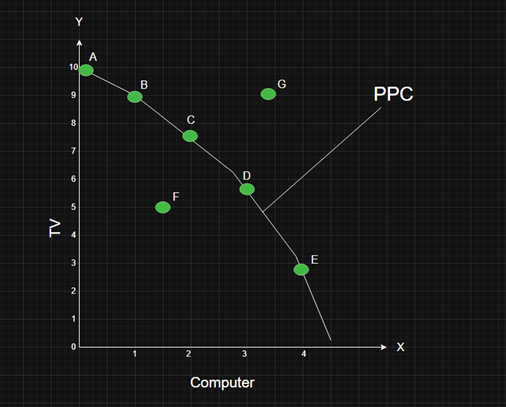
In the Production Possibility Curve (PPC) diagram, the X-axis represents the number of computers, and the Y-axis represents the number of televisions (TVs). The curve slopes downward from left to right, showing the trade-off between the two goods — meaning that to produce more computers, the economy must reduce the production of TVs. Each point on the curve such as A, B, C, D, and E, represents a possible combination of computers and TVs that can be produced when all resources are fully and efficiently used. The PPC is concave to the origin because as more computers are produced, the economy must sacrifice an increasing number of TVs. This shape reflects the law of increasing opportunity cost, which states that producing more of one good leads to a rising cost in terms of the other good forgone. Points that lie inside the curve (F) represent inefficient use of resources or unemployment, while points outside the curve (G)are unattainable with the current level of resources and technology.
Shift in PPC
A shift in the Production Possibility Curve (PPC) takes place when the productive capacity of an economy changes.
It means the economy can now produce either more or less of both goods than before.
Such shifts occur due to changes in resources, technology, or efficiency in the economy.
Outward Shift of PPC
When the PPC shifts outward, it shows economic growth.
It means the economy can produce more of both goods than before.
This happens when:
- There is an increase in resources (like labor, land, or capital).
- Technology improves, making production more efficient.
- Better education and training improve workers’ skills.
As a result, the economy becomes more productive and living standards rise.
Inward Shift of PPC
When the PPC shifts inward, it shows a reduction in the economy’s productive capacity.
It means the economy can produce less of both goods than before.
This may happen due to:
- Natural disasters (like floods or earthquakes).
- War or destruction of capital and resources.
- Loss of skilled labor or poor management.
An inward shift indicates economic decline and lower living standards.
Allocation of Resources
Allocation of resources refers to the way scarce resources, such as land, labor, capital, and entrepreneurship, are distributed among different uses to satisfy human wants. Since resources are limited and human wants are unlimited, it is important to decide what to produce, how to produce, and for whom to produce. Efficient allocation ensures that resources are used wisely and maximum satisfaction is achieved.
1. What to Produce?
Society must decide which goods and services to produce because not all wants can be fulfilled. This decision depends on factors such as consumer preferences, the availability of resources, and government policies. For example, a country may need to choose whether to use fertile land to grow food or to build factories. Making the right choice ensures that resources are used to produce the goods and services that people need the most.
2. How to Produce?
After deciding what to produce, the next step is to determine the method of production. This involves choosing how to combine resources in the most efficient and cost-effective way. Factors like technology, cost, labor, and environmental impact are considered while making this choice. For example, a farmer may have to decide whether to use modern machinery or traditional methods to grow crops. Using resources efficiently helps increase production and reduce wastage.
3. For Whom to Produce?
This question addresses the distribution of goods and services among people in society. Distribution depends on income, wealth, social policies, and market forces. For example, during a shortage of electricity, decisions must be made whether industries or households get priority. Proper allocation ensures that resources are shared fairly and that essential needs of people, especially the poor, are met.
Allocation of resources is a central problem in economics because resources are limited and human wants are unlimited. Making wise decisions about what to produce, how to produce, and for whom to produce ensures efficiency, economic growth, and social welfare. Proper allocation of resources helps create a balanced and thriving economy.
Specialization
Specialization refers to the concentration of individuals, firms, or regions on producing a limited range of goods or services. By focusing on what they do best, people or organizations can perform tasks more efficiently and with higher quality. For example, a baker specializes in making bread, while a tailor specializes in making clothes. Specialization allows workers to gain expertise, reduces mistakes, saves time, and increases productivity.
Advantages of Specialization
- Increased Efficiency: Focusing on a particular task allows workers to perform it faster and more accurately.
- Improved Skills and Expertise: Repeated practice helps workers become highly skilled and knowledgeable in their specific area.
- Higher Productivity: Specialized workers can produce more output in less time, leading to increased overall production.
- Reduced Production Costs: Efficient use of time and resources lowers costs of production.
- Better Quality of Goods and Services: Experts can produce goods that meet higher quality standards.
- Encourages Innovation: Specialization motivates workers to find new ways to improve their tasks or products.
- Economic Growth: At a national level, specialization in industries or sectors can enhance trade and economic development.
Disadvantages of Specialization
- Monotony and Boredom: Repeating the same task can make work uninteresting and reduce motivation.
- Reduced Flexibility: Workers may find it difficult to switch tasks or learn new skills.
- Dependency on Others: If one person or group fails, the whole production process can be affected.
- Over-reliance on a Single Skill or Product: Specialization in one product or service can be risky if demand falls or technology changes.
- Limited Personal Growth: Workers focusing only on a narrow task may miss opportunities to develop broader skills.
Specialization is crucial for improving efficiency, productivity, and economic growth. It allows individuals and economies to use resources wisely and produce high-quality goods and services. However, care must be taken to avoid over-specialization, as it can lead to boredom, dependency, and risk in changing economic conditions.
Division of Labour
Division of labour refers to breaking down the production process into smaller, specialized tasks, with each worker performing a specific task repeatedly. This system allows workers to focus on one part of production, become highly skilled in that task, and produce more efficiently. For example, in a car factory, one worker may install engines, another may paint the car, and another may fit the tires. By dividing labour, overall production becomes faster, more organized, and cost-effective.
Advantages of Division of Labour
- Increased Productivity: Workers become experts in their tasks, which speeds up production and increases output.
- Efficiency and Time-Saving: Specialization of tasks reduces time wasted in switching between different activities.
- Better Quality Products: Skilled workers make fewer mistakes, improving the quality of goods.
- Reduced Production Costs: Efficient and faster production lowers the overall cost of goods.
- Encourages Innovation: Repetition and focus on one task can lead workers to discover better methods or improvements.
- Supports Large-Scale Production: Division of labour is essential for mass production and meeting high demand.
Disadvantages of Division of Labour
- Monotony and Boredom: Repeating the same task can make work monotonous and reduce motivation.
- Reduced Flexibility: Workers may find it hard to learn other tasks or adapt if production methods change.
- Dependency: If one worker or section fails, it can disrupt the entire production process.
- Over-Specialization Risk: Focusing on one task may make workers or industries vulnerable to changes in demand or technology.
- Limited Skill Development: Workers may not acquire a variety of skills, limiting personal growth and adaptability.
Division of labour is a key concept for increasing efficiency, productivity, and mass production. It allows each worker to focus on a specific task, making production faster, cheaper, and of higher quality. However, it can cause monotony, reduce flexibility, and create dependency, so it should be applied carefully to balance efficiency with worker satisfaction and adaptability.
Economic System
An economic system is the way a society organizes the production, distribution, and consumption of goods and services. It answers the basic economic questions: what to produce, how to produce, and for whom to produce. In simple terms, it is the method a country uses to manage its resources and meet the needs of its people.
Types of Economic System
- Market Economy (Capitalist Economy):
- Decisions about production and distribution are made by individuals and businesses based on supply, demand, and profit.
- Resources are privately owned.
- Example: United States, Singapore.
- Socialist Economy:
- The government owns most resources and controls production and distribution.
- The focus is on equality and providing basic goods and services to all.
- Example: Former Soviet Union, China (before reforms).
- Mixed Economy:
- Combines features of both market and socialist economies.
- Resources are owned by both private individuals and the government, with decisions shared between market forces and government planning.
- Example: India, United Kingdom.
1. Market Economy (Capitalist Economy)
A market economy is based on private ownership of resources and free enterprise. Decisions about production and distribution are determined by supply and demand. Prices act as signals for producers and consumers, guiding the allocation of resources. Competition encourages efficiency, innovation, and better quality goods, while individuals and businesses have freedom to make economic choices.
Features: Private ownership, free market, profit motive, competition, minimal government intervention.
Advantages:
- Encourages efficiency and productivity.
- Promotes innovation and technological progress.
- Consumer preferences determine production.
- Freedom of choice for individuals and businesses.
- Competition improves quality and reduces costs.
Disadvantages:
- Can lead to income inequality.
- May neglect social welfare and public goods.
- Vulnerable to economic instability.
- Risk of exploitation of workers and resources.
- Essential goods may be unaffordable for the poor.
2. Socialist Economy
In a socialist economy, most resources are owned and controlled by the government. The state decides what, how, and for whom to produce, aiming to ensure equality and social welfare. Private ownership is limited, and the focus is on providing basic goods and services to all citizens rather than maximizing profit.
Features: State ownership, central planning, focus on equality, limited private ownership, social welfare orientation.
Advantages:
- Promotes equality and reduces income disparity.
- Ensures basic goods and services for everyone.
- Government can plan resources efficiently for public welfare.
- Reduces unemployment through state provision of jobs.
- Focuses on long-term social and economic goals.
Disadvantages:
- Can be inefficient due to lack of competition.
- May discourage innovation and entrepreneurship.
- Risk of bureaucratic delays and corruption.
- Resource allocation may not match consumer preferences.
- Can create dependency on government support.
3. Mixed Economy
A mixed economy combines features of both market and socialist systems. Resources are owned by both private individuals and the government. Decisions about production and distribution are made partly by the market and partly by government planning, aiming to balance efficiency with social welfare.
Features: Combination of private and public ownership, government intervention, market forces present, focus on social welfare and efficiency.
Advantages:
- Balances efficiency with social justice.
- Encourages private enterprise and innovation.
- Government intervention protects the poor and vulnerable.
- Allows flexibility to adopt market or state measures.
- Promotes stable economic growth with social welfare programs.
Disadvantages:
- Can be complex and difficult to manage.
- Conflicts may arise between government policies and private interests.
- Government interference may reduce efficiency.
- Risk of over-regulation or bureaucracy.
- Partial market control may still allow inequality.

