


Concept of Market (बजारको अवधारणा)
The term market does not only mean a physical place where goods are bought and sold. In economics, market (बजार) refers to the situation or arrangement in which buyers (किन्नेहरू) and sellers (बेच्नेहरू) come into contact—directly or indirectly—to exchange goods (सामान), services (सेवाहरू), or resources (स्रोतहरू) at an agreed price (मूल्य).
Classification of Market on the basis of Competition
1. Perfect Competition (सिद्ध प्रतिस्पर्धा)
- Features (विशेषता):
- Large number of buyers and sellers (धेरै किन्ने र बेच्नेहरू)
- Homogeneous products (उस्तै किसिमका सामान)
- Free entry and exit (आसानीसँग पस्न वा बाहिरिन सक्ने)
- Perfect knowledge of market condition (सबैलाई बजारको जानकारी हुन्छ)
- Price determined by demand and supply (मूल्य माग र आपूर्तिले निर्धारण गर्छ)
2. Imperfect Competition (असिद्ध प्रतिस्पर्धा)
It includes all market structures other than perfect competition. मुख्य प्रकारहरू:
- a. Monopoly (एकाधिकार):
- Single seller (एक मात्र विक्रेता)
- No close substitute (नजिकको विकल्प छैन)
- Full control over price (मूल्यमा नियन्त्रण हुन्छ)
- b. Monopolistic Competition (एकाधिकारात्मक प्रतिस्पर्धा):
- Many sellers (धेरै विक्रेता)
- Product differentiation (समान तर केही फरक भएको सामान, जस्तै साबुनका ब्रान्ड)
- Some control over price (थोरै मूल्य नियन्त्रण)
- c. Oligopoly (अल्पाधिकार):
- Few sellers dominate (केवल थोरै विक्रेताले बजार नियन्त्रण गर्छन्)
- Interdependence between sellers (एक–आपसमा प्रभाव पर्छ)
- Example: telecom, airline, petrol companies
Concepts of Total, Average and Marginal Revenue
1. Total Revenue (TR) – कुल राजस्व
- Concept (अवधारणा):
Total Revenue is the total amount of money a firm receives from selling a given quantity of goods or services.
Formula:
TR = Price × Quantity
2. Average Revenue (AR) – औसत राजस्व
- Concept (अवधारणा):
Average Revenue is the revenue earned per unit of output sold.
Formula:
AR =
3. Marginal Revenue (MR) – सीमान्त राजस्व
- Concept (अवधारणा):
Marginal Revenue is the additional revenue generated by selling one more unit of output.
Formula:
MR =
Relationship among TR, AR, MR (TR, AR, MR बीचको सम्बन्ध)
- TR is the total.
- AR is per unit revenue.
- MR is extra revenue from the last unit sold.
- Under perfect competition (सिद्ध प्रतिस्पर्धा):
AR = MR = Price
- Under imperfect competition (असिद्ध प्रतिस्पर्धा):
MR < AR
Revenue Curves under Perfect Competition Market
Total, Average and Marginal Revenue of a competitive firm
| Units of output(Q) | Per unit Price(p) | TR = P | AR = TR/Q | MR = |
| 0 | 10 | 0 | – | – |
| 1 | 10 | 10 | 10 | 10 |
| 2 | 10 | 20 | 10 | 10 |
| 3 | 10 | 30 | 10 | 10 |
| 4 | 10 | 40 | 10 | 10 |
| 5 | 10 | 50 | 10 | 10 |
| 6 | 10 | 60 | 10 | 10 |
| 7 | 10 | 70 | 10 | 10 |
Total Revenue (TR)
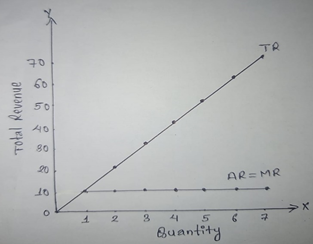
In the figure, the X-axis represents quantity and the Y-axis represents total revenue. The TR curve is an upward sloping straight line from the origin, which shows that total revenue increases in the same proportion as the quantity sold. This happens because, under perfect competition, the price of the product remains constant. As a result, every additional unit sold adds the same amount of revenue. The horizontal line in the figure represents Average Revenue (AR) and Marginal Revenue (MR), which are equal to the price. Thus, under perfect competition, AR = MR = Price, and TR increases proportionally with output.
Average Revenue (AR)
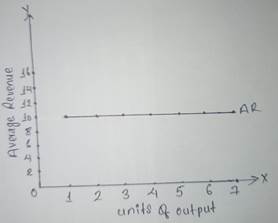
In the figure, the X-axis measures units of output and the Y-axis measures Average Revenue (AR). The AR curve is drawn as a horizontal straight line parallel to the X-axis at the level of 10. This indicates that the firm is selling its product at a constant price of 10 per unit. Under perfect competition, the price of the product is determined by the market and remains the same regardless of the level of output produced and sold by an individual firm. Therefore, the Average Revenue (AR) is constant and equal to the market price. Since AR = Price, the AR curve under perfect competition is always a straight horizontal line.
Marginal Revenue (MR)
In the diagram, the X-axis shows units of output and the Y-axis shows marginal revenue. The MR curve is a horizontal straight line parallel to the X-axis at the level of 10. This shows that every additional unit of output sold adds the same amount of revenue to the firm. Under perfect competition, the price remains constant, so MR = Price = AR. Hence, the marginal revenue curve is a straight line, indicating that the firm earns equal revenue from each additional unit sold.
Revenues under Monopoly Market
Monopoly Market (एकाधिकार बजार)
A monopoly market is a type of market where there is only one seller (विक्रेता) who controls the entire supply (आपूर्ति) of goods or services. In this type of market, there are no competitors (प्रतिस्पर्धी), so the seller has full control over the price and quantity of the product. The buyers (खरिदकर्ता) are completely dependent on that single seller (विक्रेता).
Short form: Monopoly Market = One seller (विक्रेता) + Many buyers (खरिदकर्ता).
Total, Average and Marginal Revenue of a Monopoly
| Units of output(Q) | Per unit Price(p) | TR = P | AR = TR/Q | MR = |
| 1 | 10 | 0 | – | – |
| 2 | 9 | 10 | 10 | 10 |
| 3 | 8 | 20 | 10 | 10 |
| 4 | 7 | 30 | 10 | 10 |
| 5 | 6 | 40 | 10 | 10 |
| 6 | 5 | 50 | 10 | 10 |
| 7 | 4 | 60 | 10 | 10 |
| 8 | 3 | 70 | 10 | 10 |
Total Revenue (TR)
The total amount of sales receipt or money value received by a monopolist by selling various quantities of his product in a given period of time is his total revenue. TR, at each level of output, can be found by multiplying the amounts of sale/output by the market price, i.e. TR = PQ, where P = market price, Q = of sale.
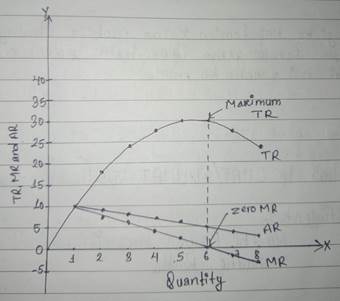
The table shows how Total Revenue changes in a Monopoly Market. As the output increases from 1 to 8 units, the price per unit decreases from 10 to 3. Despite the falling price, the Total Revenue rises steadily from 0 to 70 because selling more units increases overall revenue. This demonstrates that in a monopoly, the seller can increase Total Revenue by selling more units, even if it means lowering the price.
Average Revenue and Marginal Revenue (AR and MR)
Relationship between TR, AR and MR
1. Relationship between TR and MR
- When MR is positive, TR increases.
- When MR is zero, TR is maximum.
- When MR is negative, TR decreases.
- MR is the slope of the TR curve, showing how much TR changes with each extra unit sold.
2. Relationship between AR and MR
- AR is the revenue per unit sold, while MR is the additional revenue from selling one more unit.
- When AR is constant, MR = AR (as in perfect competition).
- When AR falls, MR lies below AR (as in imperfect competition).
- MR falls faster than AR, and both curves are downward sloping under imperfect competition.

