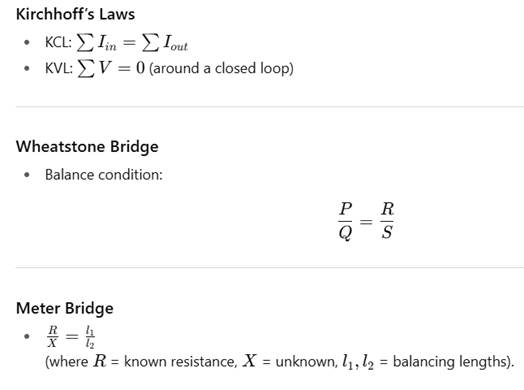
14.1 Kirchhoff’s Laws
- Kirchhoff’s Current Law (KCL): At any junction, the sum of currents entering = the sum of currents leaving.
- Kirchhoff’s Voltage Law (KVL): The algebraic sum of potential differences in a closed loop = 0.
🔹 Example:
At a junction, currents 2 A, 3 A, and 4 A are entering. Find outgoing current.

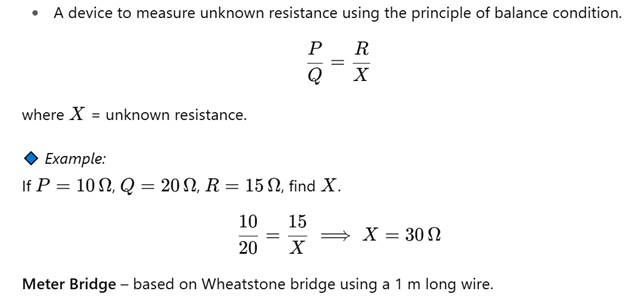
14.2 Wheatstone Bridge Circuit; Meter Bridge
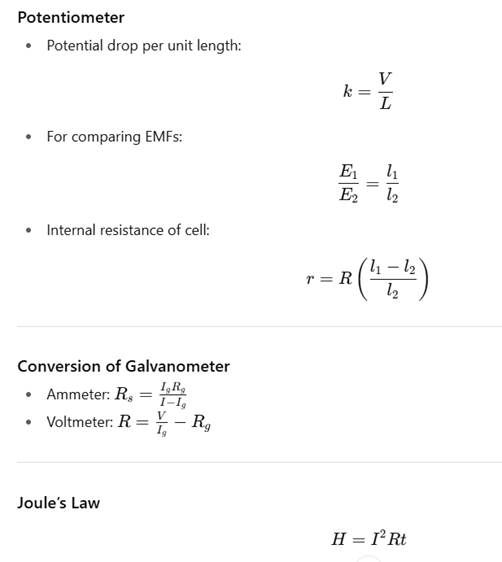
14.3 Potentiometer
14.4 Super Conductors; Perfect Conductors
- Superconductor: A material with zero resistance below a critical temperature.
- Perfect conductor: No resistance but not necessarily superconducting.
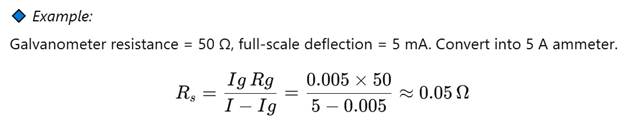
14.5 Conversion of Galvanometer
- To Voltmeter: Add high resistance in series.
- To Ammeter: Add low resistance (shunt) in parallel.
14.6 Joule’s Law
Important Short Questions and Answers in Short
Q1. What are Kirchhoff’s Laws?
- KCL (Current Law): Sum of currents entering a junction = sum of currents leaving the junction.
- KVL (Voltage Law): Algebraic sum of potential differences around any closed loop is zero.
Q2. What is the condition for Wheatstone bridge balance?
👉 Bridge is balanced when:
P/Q = R/S
(No current flows through galvanometer).
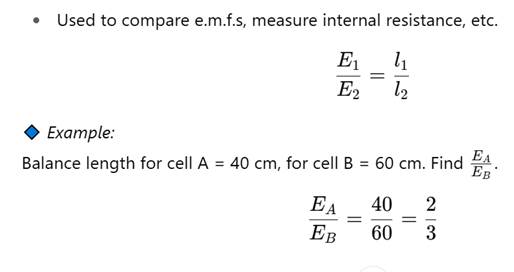
Q3. What is the principle of a potentiometer?
👉 The potential drop across a wire is proportional to its length if current is constant.
Q4. How can the internal resistance of a cell be measured using a potentiometer?
👉 By comparing the balancing lengths with and without an external resistance.
Q5. What is a superconductor?
👉 A material that has zero electrical resistance and perfect diamagnetism (expels magnetic field) below a certain critical temperature.
Q6. How do you convert a galvanometer into an ammeter?
👉 Connect a low resistance shunt (Rs) in parallel.
Q7. How do you convert a galvanometer into a voltmeter?
👉 Connect a high resistance (R) in series.
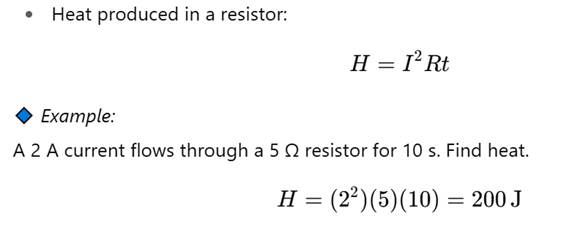
Q8. State Joule’s Law of Heating.
👉 Heat produced (H) in a conductor is proportional to:
- square of current (I²),
- resistance (R),
- time (t).
H=I ²Rt
✅ Formula Sheet (Quick Revision)
Kirchhoff’s Laws