17.1 7.1 Magnetic Field Lines and Magnetic Flux
- Magnetic field lines: Imaginary curves showing the direction of the magnetic field.
- Outside magnet → from North pole to South pole.
- Inside magnet → from South pole to North pole.
- Properties:
- Never intersect.
- Denser lines → stronger field.
- Continuous closed loops.
Magnetic flux (Φ):
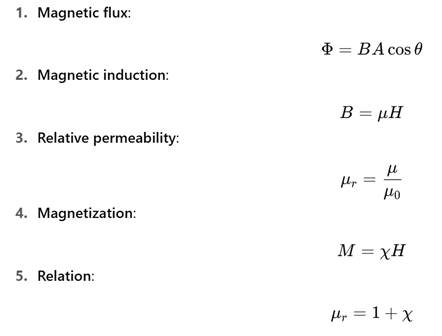
Φ=B⋅A⋅cosθ
where B = magnetic field, A = area, θ = angle between field & area normal.
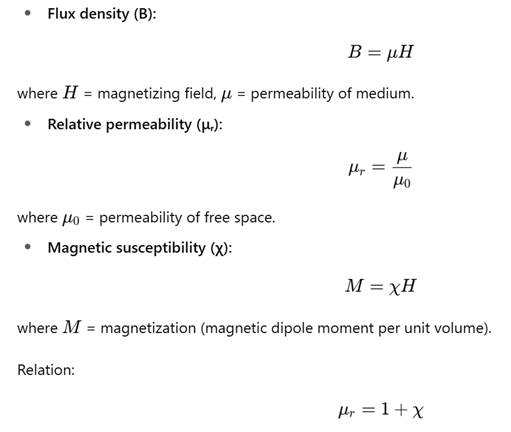
17.2 Flux Density, Relative Permeability, Susceptibility
17.3 Hysteresis
When a ferromagnetic material is magnetized and demagnetized repeatedly, a hysteresis loop is formed between B vs H.
Key terms:
- Retentivity → ability of material to retain magnetization.
- Coercivity → magnetizing field required to reduce B=0.
- Area of loop → energy loss per cycle.
Applications:
- Permanent magnets → high retentivity & coercivity.
- Transformer cores → low hysteresis loss (small loop).
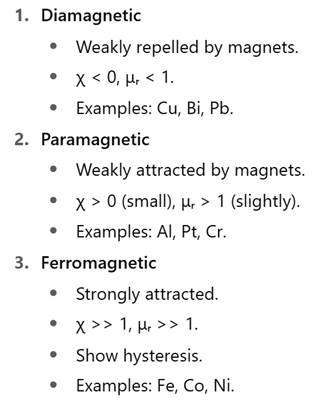
17.4 Types of Magnetic Materials
Short Questions and Answers in Short
Q1. Define magnetic flux.
👉 Total magnetic field passing through a surface.
Q2. What is the relation between susceptibility and relative permeability?
👉 μr=1+χ.
Q3. Give one example each of diamagnetic, paramagnetic, and ferromagnetic materials.
👉 Diamagnetic: Copper; Paramagnetic: Aluminium; Ferromagnetic: Iron.
Q4. What is hysteresis?
👉 The lag of magnetization behind the magnetizing force when a ferromagnetic material is magnetized and demagnetized.
Q5. Which type of materials are used for making permanent magnets?
👉 Ferromagnetic materials with high retentivity and coercivity.
Q6. Which type of materials are used in transformer cores? Why?
👉 Ferromagnetic materials with low hysteresis loss, e.g., soft iron.
Q7. Why are diamagnetic materials repelled by a magnet?
👉 Because they develop an induced magnetic moment opposite to the applied field.
Q8. State one property of ferromagnetic materials.
👉 They retain magnetism even after the magnetizing field is removed (retentivity).
✅ Formula Sheet (Quick Revision)
Numerical Problems
Example 1: Magnetic flux through a tilted surface
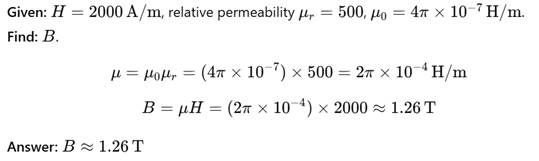
Example 2: Flux density in a magnetic material
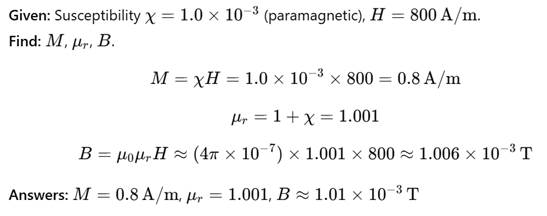
Example 3: Magnetization, permeability and B
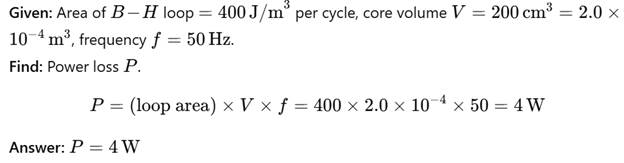
Example 4: Hysteresis power loss
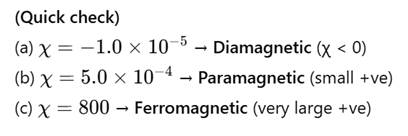
Example 5: Identify material type from χ