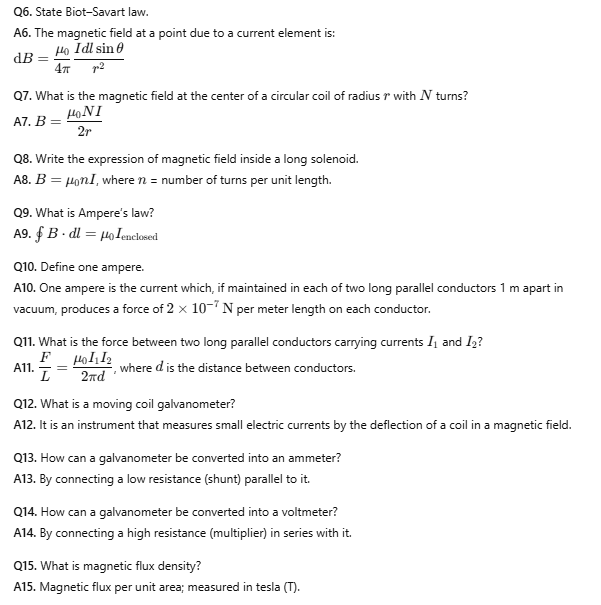
16.1 Magnetic field lines & magnetic flux; Oersted’s experiment
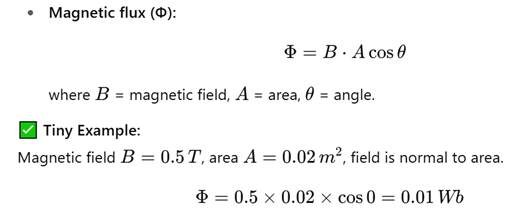
16.2 Force on moving charge; Force on a conductor
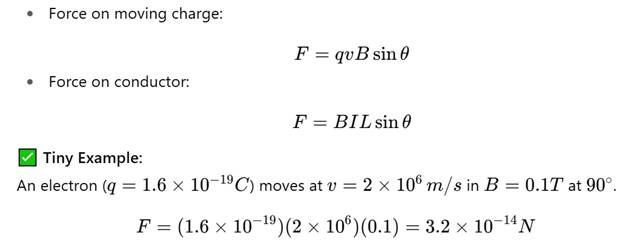
16.3 Force & Torque on Rectangular Coil, Moving Coil Galvanometer
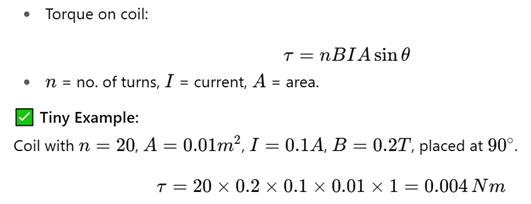
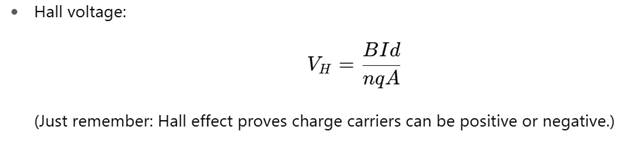
16.4 Hall Effect
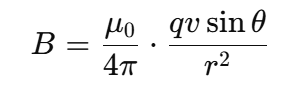
16.5 Magnetic field of a moving charge
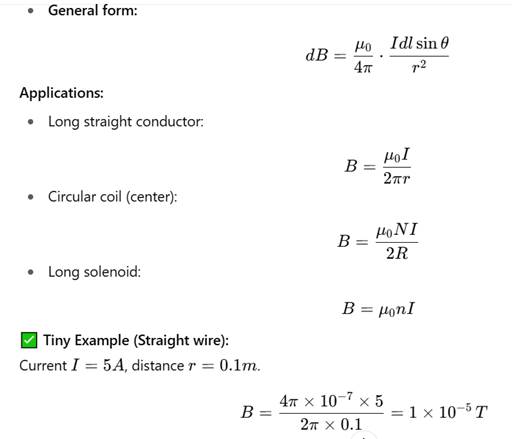
16.6 Biot–Savart Law
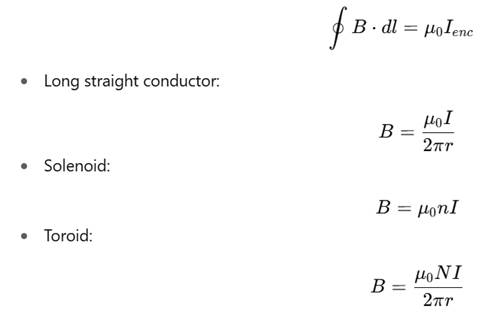
16.7 Ampere’s Law
16.8 Force between Two Parallel Conductors (Definition of Ampere)

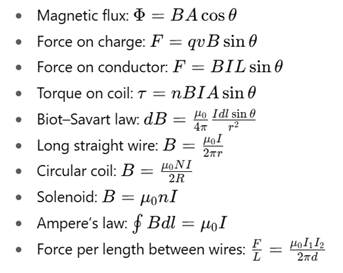
✅ Quick Revision Formula Sheet (Chapter 16)
Short Important Questions and Answers in Short
Q1. What did Oersted’s experiment show?
👉 Oersted discovered that a current-carrying conductor produces a magnetic field around it, shown by the deflection of a nearby compass needle.
Q2. How is 1 Ampere defined?
👉 When two parallel conductors 1m apart exert a force of 2×10⁻⁷N/m on each other.
Q3. Why is Hall effect important?
👉 It shows whether charge carriers are positive or negative.
Q4. Write formula of torque on current loop.
👉 τ= nBIAsinθ
Q5. What is magnetic flux?
👉 Magnetic flux (Φ) is the total number of magnetic field lines passing through a given surface. It is given by: Φ=BAcosθ
Q6. Write the formula for the force on a moving charge in a magnetic field.
👉 F=qvBsinθ
More Questions and Answers: