21.1 Quantum Nature of Radiation
- Light has dual nature: wave + particle (photon).
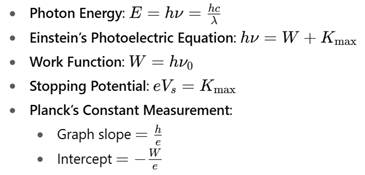
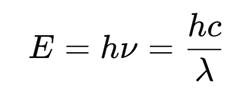
- Photon energy:
- Photons explain phenomena like photoelectric effect, Compton effect.
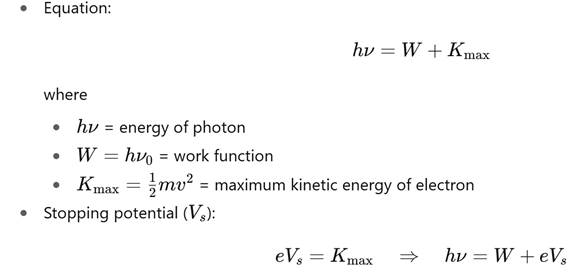
21.2 Einstein’s Photoelectric Equation; Stopping Potential
- Photoelectric effect: Emission of electrons when light of frequency ν≥ν0\nu \geq \nu_0ν≥ν0 falls on a metal.
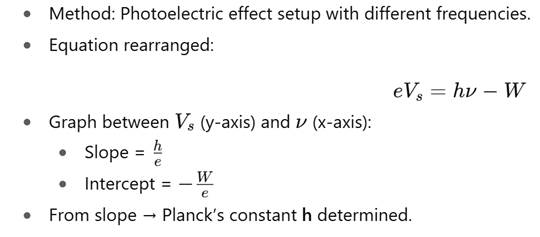
21.3 Measurement of Planck’s Constant
Short Questions and Answers in Short
Q1. What is the quantum nature of light?
👉 Light consists of discrete photons with energy hν.
Q2. Define work function.
👉 Minimum energy required to remove an electron from metal surface.
Q3. State Einstein’s photoelectric equation.
👉 hν=W+Kmax.
Q4. What is threshold frequency?
👉 Minimum frequency of light needed to eject electrons.
Q5. Write relation between stopping potential and maximum kinetic energy.
👉 eVs=Kmax.
Q6. On which factors does stopping potential depend?
👉 Only on frequency of incident light (not on intensity).
Q7. How can Planck’s constant be determined experimentally?
Q8. What is the effect of increasing intensity of incident light in photoelectric effect?
👉 Increases number of photoelectrons but not their energy.
Q9. Why is photoelectric effect not explained by wave theory?
👉 Because wave theory predicts energy depends on intensity, but experiment shows dependence on frequency.
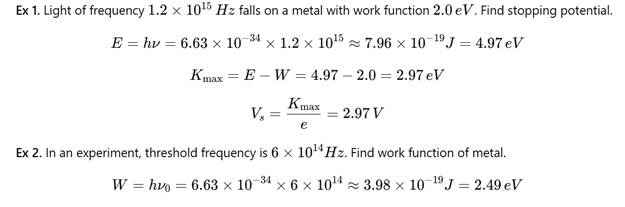
Numerical Examples
✅ Formula Sheet (Quick Revision)