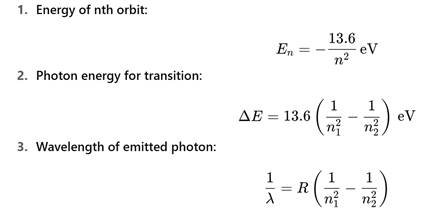
23.1 Bohr’s Theory of Hydrogen Atom
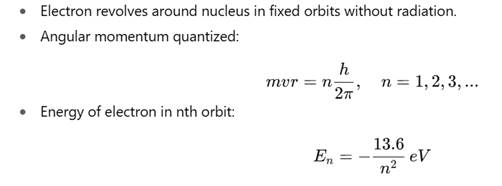
23.2 Spectral Series; Excitation and Ionization Potentials
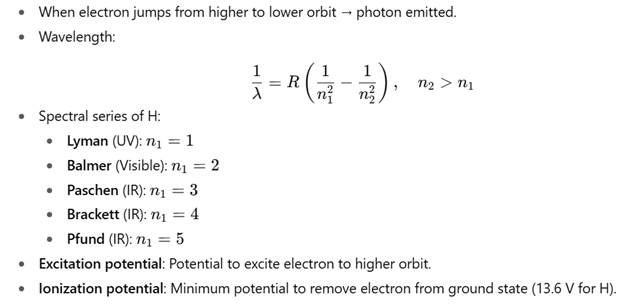
23.3 Energy Level; Emission and Absorption Spectra
- Energy level diagram: Negative energy values (closer to 0 for higher orbits).
- Emission spectrum: Produced when electron jumps down → photon emitted.
- Absorption spectrum: Produced when electron absorbs energy to jump up → dark lines in spectrum.
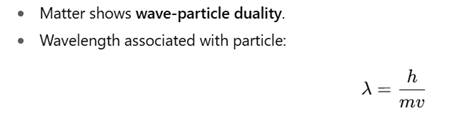
23.4 De Broglie Theory; Duality
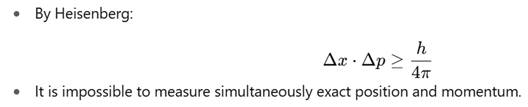
23.5 Uncertainty Principle
23.6 X-rays: Nature, Production & Uses
- Nature: High frequency EM waves.
- Production: When fast-moving electrons hit a metal target (cathode ray tube with tungsten target).
- Types:
- Continuous X-rays (braking radiation)
- Characteristic X-rays (inner shell transitions)
- Uses: Medical imaging, cancer treatment, crystallography, detecting flaws in materials.
23.7 X-rays Diffraction, Bragg’s Law
- X-rays diffracted by crystal planes.
- Condition of constructive interference:
2dsinθ=nλ
where d = spacing between crystal planes.
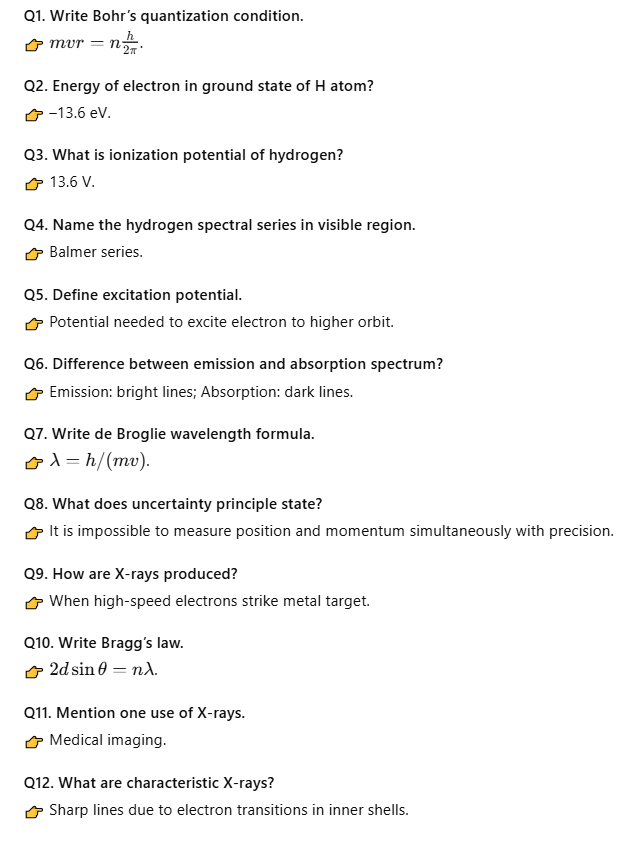
Short Questions and Answers in Short
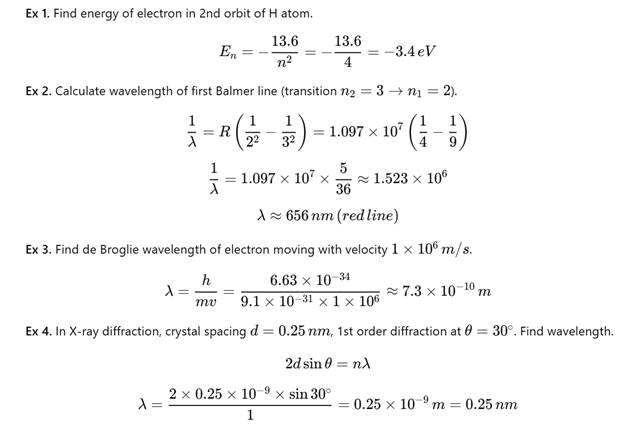
Numerical Examples
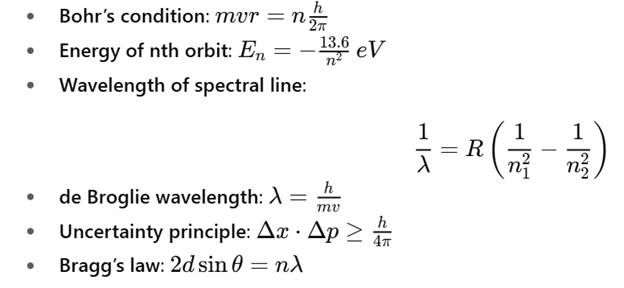
✅ Formula Sheet (Quick Revision)
Hydrogen Spectral Series (Chart for Quick Revision)
| Series | Lower Orbit (n₁) | Higher Orbit (n₂) | Region of Spectrum |
| Lyman | 1 | 2, 3, 4… | Ultraviolet (UV) |
| Balmer | 2 | 3, 4, 5… | Visible |
| Paschen | 3 | 4, 5, 6… | Infrared (IR) |
| Brackett | 4 | 5, 6, 7… | Infrared (IR) |
| Pfund | 5 | 6, 7, 8… | Infrared (IR) |
| Humphrey | 6 | 7, 8, 9… | Infrared (IR) |
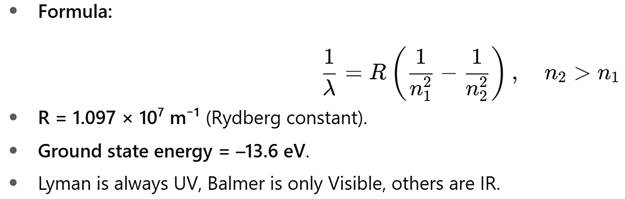
Energy Levels of Hydrogen Atom
| Energy Level (n) | Energy (eV) | Remarks |
| n = 1 | –13.6 eV | Ground state |
| n = 2 | –3.4 eV | First excited state (Balmer starts) |
| n = 3 | –1.51 eV | Second excited state (Paschen) |
| n = 4 | –0.85 eV | Brackett |
| n = 5 | –0.54 eV | Pfund |
| n = 6 | –0.38 eV | Humphrey |
| n = ∞ | 0 eV | Ionization limit (free electron) |
Transitions & Series
- Lyman series: Transitions → n = 1 (UV region).
- Balmer series: Transitions → n = 2 (Visible region).
- Paschen, Brackett, Pfund, Humphrey: Transitions → n = 3, 4, 5, 6 (Infrared).